Why This Topic Landed in Japan
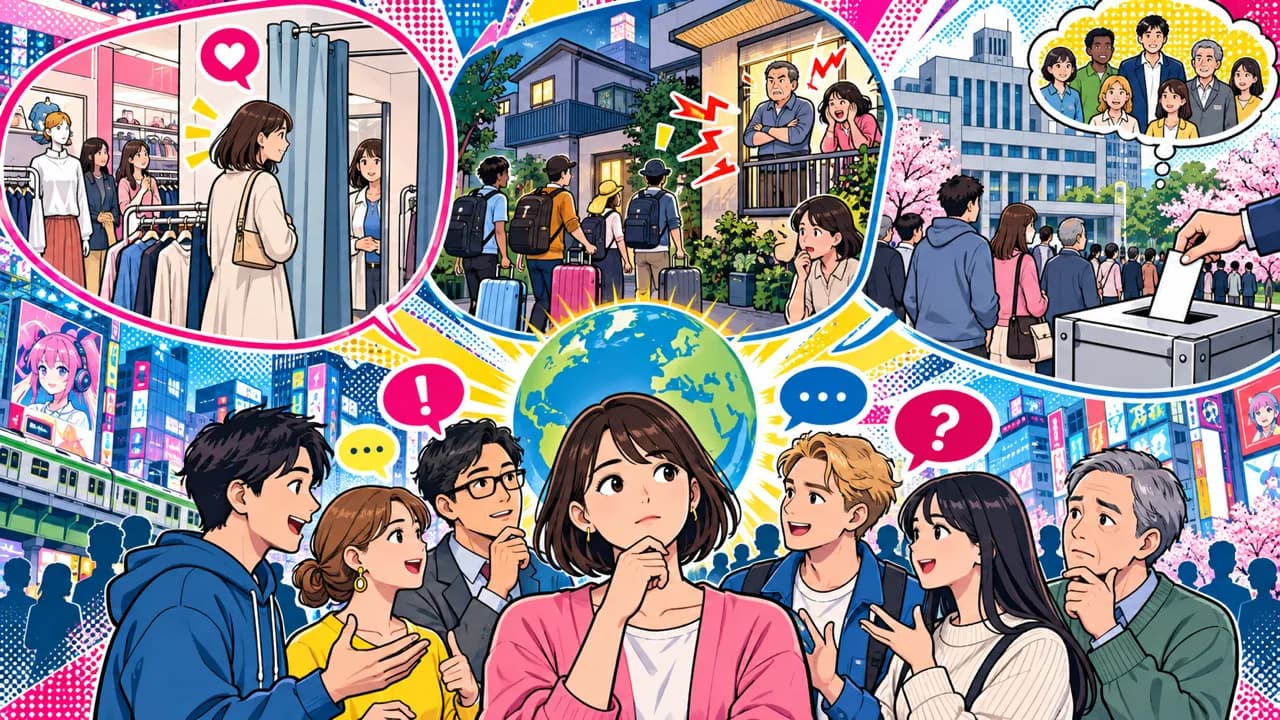
Friction over Japan's expanding acceptance of foreign residents is a recurring subject, but this time three things converged. Toyama Prefecture published a draft "multicultural coexistence" ordinance whose Article 6-2 asks residents to "make efforts to cooperate" with coexistence policy — a duty-of-effort provision, not a ban on opposition. A pair of naturalized figures — a Setagaya ward assembly member born in Uzbekistan and a Korean-born businessman — launched a political group, "Shinsei-tō," to promote local participation by residents with foreign roots. And reports spread of Vietnamese buyers lining up at convenience stores to corner and resell Pokémon cards. Together these moved the debate from everyday friction to an institutional and political register: an ordinance written into law, naturalized citizens organizing politically, and work visas hollowed out into resale hustles. Distrust of European immigration policy sits underneath much of the reaction.
Key Reaction Themes
- Alarm at institutionalization and political organizing (most common) — Most comments treated the ordinance's effort-duty and the naturalized-led party as a "takeover" or "forced multiculturalism," and much of that alarm was framed in sweeping terms about national origin.
- Redirecting blame to national policy — A recurring counter that the real problem is the ruling party admitting immigrants en masse without even regulating real estate, rather than one naturalized local lawmaker.
- Fighting it through procedure — Practical calls to submit public comments, petition lawmakers, join support groups, and vote — opposing through process rather than emotion.
- A rule-of-law defense (a minority) — A smaller group argued that naturalized citizens are Japanese and have every right to form a party and take part in politics, and that opponents haven't even read the full text.
What Japanese Netizens Are Saying
Toyama's draft multicultural-coexistence ordinance
A draft prefectural ordinance asking residents to make efforts to cooperate with coexistence policy set off a fight centered on the public-comment period.

🆘皆さん助けてください!拡散願います🙇 これが最期の機会です。 皆さんに協力いただいたパブコメで 全員が反対した「富山県多文化共生条例」 それでも共生を課す条例の制定を諦めない富山県 これが最期の意見募集になります。 期間がありません。どうか助けてください😢 pref.toyama.jp/140631/comment…


「富山県多文化共生条例」についてですが、私も断固反対ですから意見を送っておきました。 ヨーロッパの惨状を見ても未だに多文化共生(移民政策)を推進する政治家や政党は何を見ているのでしょう? 惨状を知らないのか利権目的なのかわかりませんが、いずれにせよ政治家としての資質は無いですね。

Comments:
- "This will absolutely spread nationwide. Once it happens, it'll be used forever as justification to push the same kind of law in other regions."
- "Forcing residents to 'cooperate with the policy' — a vague, sweeping obligation — is wrong from the start. Do they have no regard for democracy or freedom of thought and conscience?"
- "I don't get why they're so eager to bring in foreigners. What's the intent behind making an ordinance like this? Somebody explain."
- "Toyama voters who elected the lawmakers pushing this are just fools. Research candidates' backgrounds, ties, and interest groups properly — you can gather info easily with social media and AI. Choose your lawmakers carefully at the ballot box. Go vote."
- "A prefecture with rotten lawmakers is proof its residents are deeply politically apathetic. It's all the result of that apathy. Recognize that you're being an embarrassing adult."
- "Let's have the lawmakers who voted yes take immigrants into their own homes first."
- "Even for a garbage ordinance there are those pushing it and those opposing it. Send petitions to the opposing lawmakers who have clout, join their support groups, and donate personally if you can. That's what it means for a lawmaker to have power."
- "Media, lawyers, and NPOs come as a set to ram it through, so it takes courage to voice opposition locally."
- "Why do we have to sacrifice our own culture to coexist with multiple cultures? People from other countries should adapt to Japan."
A political party led by naturalized citizens
A political group launched by naturalized figures from Uzbekistan and Korea was read as a "foreign bloc" entering politics and went up in flames online.

【重大なご報告】 本日、9月14日、縁起が良いとされる大安であり、一粒万倍日に、 内幸町の日本プレスセンターで記者会見を開きました。 この度、新しい政治団体「新世党」を設立致しました。 記者会見に日本と海外のメディアの方々たくさんお越し頂きました。 Show more


最悪だ…やはり簡単に帰化を認めてはいけないと思う。こんなの侵略としか思えない… 帰化人同士で新政党作って、帰化人がそこに投票して、どんどん勢力伸ばしたら…もう乗っ取りですね。今スウェーデンで起きているような事になる。 自民党しっかりしろよ!!!日本を守れよ!

多文化共創?馬鹿げたことを言うな。 それで出来上がる世界は日本とは別の世界。 祭りで御輿を担ぐ人が少なかったらどうするつもりなんだよ。 外人が御輿を担ぐのかよ。 その時点で日本の文化が変容してるわ。 ムスリムについてもどう思ってんだよ。 文化と文化の共生など無理。共産思想そのもの。
Comments:
- "It's strange that first-generation naturalized citizens can become lawmakers at all."
- "A bigger problem than naturalized local lawmakers is the ruling party letting in immigrants en masse and not even regulating real estate."
- "It's all opposition from people who haven't read the whole thing."
- "You always tell them to naturalize if they want to take part in politics, and then when they do, you complain anyway."
- "People who've naturalized are Japanese, so there's no problem, lol."
- "I get that naturalized people are Japanese. But using that to build a foreign bloc inside Japan is a different matter."
- "At least coexist by adapting to Japan. Why does Japan have to be the one adapting?"
- "It'd be better to restrict them up to the third generation after naturalization."
- "It's off the moment you treat your naturalized self as something special. Once you choose to naturalize you're Japanese, so you should discard your past roots — and if you can't, I don't think naturalization should be granted."
Organized Pokémon-card scalping by Vietnamese buyers
Reports of Vietnamese buyers queueing at convenience stores to corner and resell Pokémon cards drew a backlash.

近所のローソン人多すぎ レジ待ちの人、言語や顔見る限りほぼベトナム人 朝から暇そう。日本に働きに来たのではなく、ポケモンカードの転売しに来たのね。 ベトナム縦断ツーリング達成したし、反越感情ははないつもりなのだけどこれでは好感持てん まあ日本の実習生制度も問題なのだけど…


ベトナム人 お着替え中 #ポケモンカード


Comments:
- "This is Mercari's and the LDP's fault."
- "They should refuse to sell unless you can name ten Pokémon and ten Pokémon Trainers."
- "The Vietnamese folks working at Hotel Mikazuki try hard and gave good service — the cream of the crop, I guess. It ends up like this because the technical-intern system tries to gather cheap slave labor."
- "A penalty system is supposed to have started back home, so aren't these guys going back? Surely they're not here illegally?"
- "The worst are the sellers, right? It's just a matter of Japanese or foreign. Either way, all scalpers are gross."
- "When selling Pokémon cards, call the police and have them check residence permits — it'd be a feeding frenzy of arrests."
- "Mercari is actually responding for once — apparently the 30th-anniversary ones are banned from listing for the time being."
- "Use the My Number card. Seriously, what's the My Number card even for?"
- "Report them to immigration — a side gig of scalping Pokémon cards isn't authorized, is it?"