Why This Topic Landed in Japan
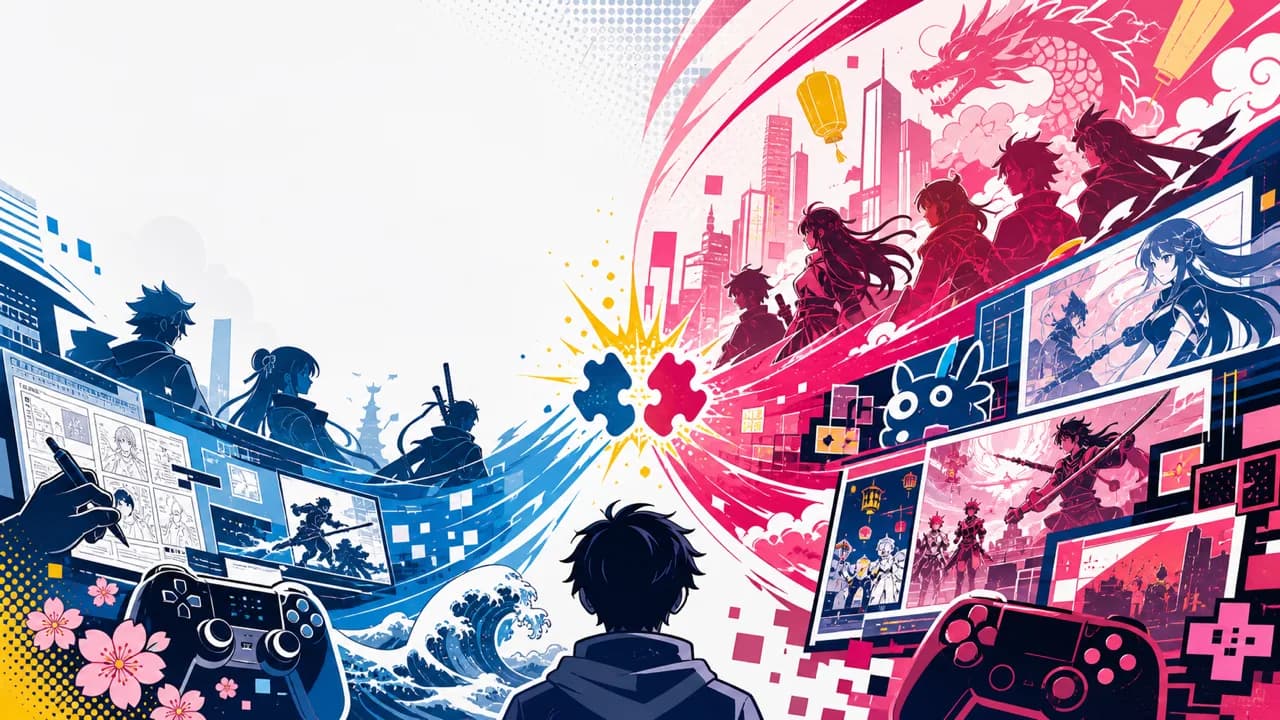
Anime and games are a source of cultural pride for Japan, so the claim that "China has surpassed us" strikes a nerve. A social-media post declaring that "recent Chinese anime is scary good—is Japan going to be okay?" reignited the debate, alongside a widely shared Chinese online discussion about why people can tell Chinese and Japanese animation apart at a glance. AI-driven mass production, and the reality that Chinese staff already handle much of the animation work on Japanese titles, generate both anxiety and pushback. The claim that Chinese animation has "overtaken" Japan is a subjective, argument-driven framing rather than an established industrial fact. Running in parallel, a "fake Doraemon" operating openly in China as dorayaki shops and cafés—turned into a tourist attraction—served as a symbol of the deep-seated distrust over China's treatment of intellectual property.
Key Reaction Themes
- Acknowledging the rise, with caveats — "They can brute-force volume with AI," and "the animators are already mostly Chinese," set against "it's uniform and flat" and "it won't win broad appeal as long as it courts the Communist Party."
- A case-by-case stance — "If it's good, I don't care where it's from."
- Exasperation at imitation, and self-reflection — Sarcasm about a "copyright-free nation" sits beside the reminder that "Japan copied too during its high-growth years."
What Japanese Netizens Are Saying
The argument over whether Chinese anime has surpassed Japan's
Sparked by a viral "recent Chinese anime is scary good" post and a Chinese online debate on telling the two apart at a glance, opinions split over Chinese animation's real strength.

最近の中国アニメの本気度がヤバすぎる 日本大丈夫かこれ...
Sources: Record China
Comments:
- "Thanks to AI, sheer volume has become the whole point, so China and India—who can throw around brute-force numbers—are strong."
- "It's evenly spaced, flat 3D animation just tracing a guide, so no Japanese person could do it lol. Reeks way too much of Chinese propaganda."
- "It's true that many Japanese anime studios, harmed by cranking out nothing but trashy 'isekai' series, can't make a decent story-driven work anymore and are visibly declining in technique, though."
- "If it's good, I don't care whether it's Chinese or Korean."
- "It has a distinctive quirk—which isn't a flaw in itself—but because it's imitating Japanese anime, it ends up feeling off."
- "These days the people doing the animation on Japanese anime are full of Chinese staff, though."
- "The high-quality stuff is Chinese now, after all."
- "Sure, then tell me which high-quality Chinese anime you mean."
China's "fake Doraemon" becomes a tourist attraction
A "fake Doraemon" was reported to be operating openly in China as dorayaki shops and cafés and had become a tourist spot, drawing criticism over disregard for copyright.
Sources: Smart FLASH, 2ch
Comments:
- "It's China, right? This is nothing new. They've been making knockoffs of everything Japanese for ages."
- "China quality, the pride of the world."
- "The Chinese having no morals at all is actually their strength—kind of enviable. For 30 years they've grown fast entirely through espionage, tech theft, knockoffs, and skirting the law. Japan was like that too during its high-growth years, but now it's bound by compliance and has become too much of a goody-goody."
- "Japan ripped off Doraemon too back in the day, but everything except that Umaibo mascot guy has disappeared."
- "Shogakukan isn't in a position to complain about Doraemon's rights—the ones who can do that are Fujiko F. Fujio Pro."
- "Korea has a Doraemon knockoff manga called Tonchamon."
- "The scary part about them is that the Chinese government tacitly allows it. The laws and common sense that should be the foundation aren't functioning."
- "China, the copyright-free nation."