Why This Topic Landed in Japan
A weak yen and stagnant real wages have made "Japan has grown poorer" a widely shared feeling, and the firsthand accounts of residents and travelers abroad were received as backing for it. At the same time, there is a durable counter-view that free water, safety, and cheap, high-quality service make the country plenty comfortable, along with a reframing that "the bubble-era wealth was the anomaly." The "over 1,000 yen" figure for German water includes bottled pricing and is higher than a typical glass. The accounts from a resident of Australia and a Singapore traveler are individual experiences, and do not on their own show that "Japanese tourists have plummeted" or that "the whole country is impoverished"; in fact, outbound Japanese travelers in January 2026 were up 17.6% year on year, so single anecdotes do not establish a broad decline in overseas travel.
Key Reaction Themes
- A felt sense of decline, and self-deprecation — The most common strand: "everything is expensive abroad," "imports are a rich person's luxury," and "you don't see Japanese travelers anymore."
- Relativizing and the counter-view — A strong strand held that the bubble years were abnormal, and that a country with free water, safety, and cheap good food is still very livable.
- Background and factual corrections — Cooler notes added that seaweed was always a luxury, that serving proper water would cost about the same in Japan, and that German incomes are more than double.
What Japanese Netizens Are Saying
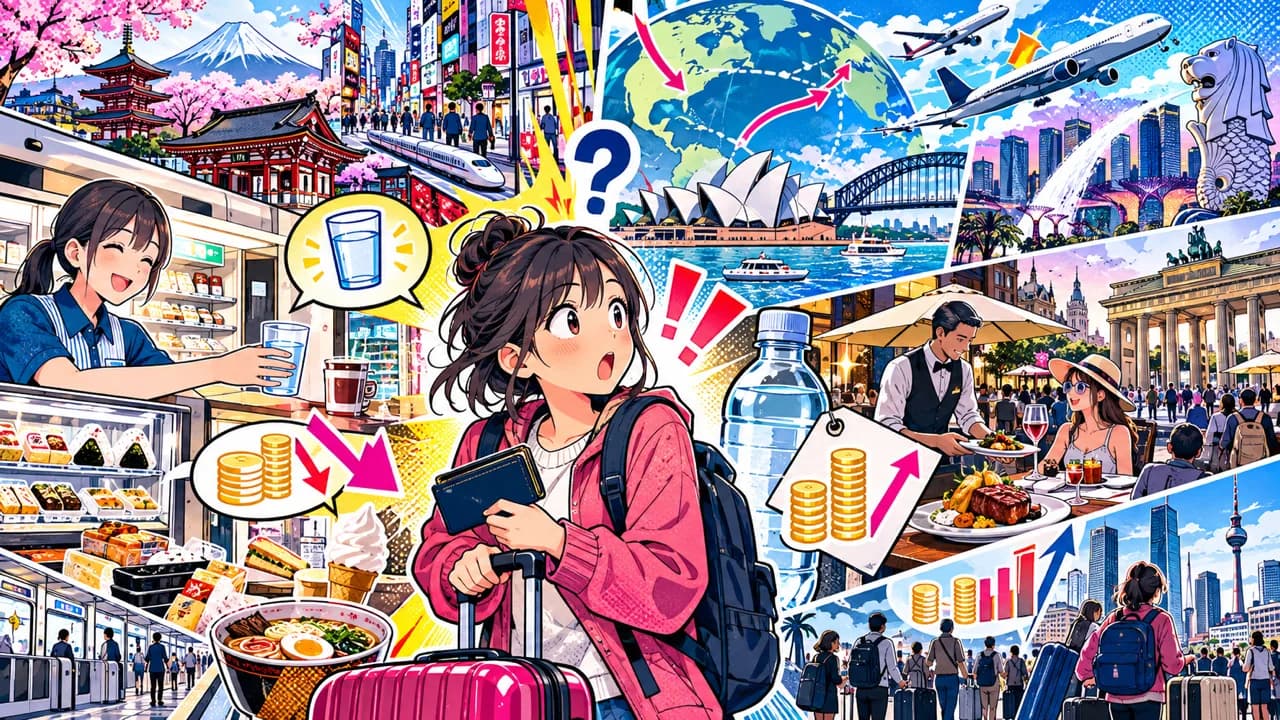
An Australia resident: "Skimping even on the seaweed?"
A resident abroad, startled on a visit home by how much people were economizing, set off a debate over prices and wages.

日本のみなさんに聞きたいんですが、日本っておにぎりの海苔も節約するくらい貧乏になったんでしょうか。 本当に何があったのか結構びっくりしてます。

Comments:
- "No idea about the countryside, but in the cities absurdly expensive stuff still flies off the shelves, so that's not it. People have a line of 'I won't pay more than this at a mere convenience store,' and the stores just can't keep offering products at that price point anymore."
- "Nori was originally a luxury item, the kind of thing you'd give as a midyear gift. At some point it got discounted heavily, and now it feels like it's gone back to being a luxury."
- "Giving nori as a funeral thank-you gift was a thing precisely because it was expensive and appreciated."
- "Median annual income for ordinary workers by country: Japan 1990 ¥5.5M → 2026 ¥3.5M (non-regular low-income rate over 40%, tax-and-social-insurance burden up from 10% to 45%); US 1990 $30k → 2026 $85k (¥13M); China 1990 ¥2,000 yuan → 2026 ¥120k yuan. And Japan is the only country in the world where workers' wages kept falling for over 30 years. On top of prices more than doubling — of course it ends up like this."
- "Prices rose way more than wages did. These days even chocolate is too expensive to buy casually."
- "Grabbing just a little at Don Quijote came to 2,000 yen — that got a laugh out of me."
- "FamilyMart uses Korean-made nori, and it's cheap."
A German marvels at Japan's "free water"
A story that water, paid for in Germany, is free in Japan opened a debate over the value of everyday infrastructure.

Sources: Yahoo! news
Comments:
- "It's a country where they drink beer instead of water, after all."
- "Japanese people go out of their way to drink imported water when they can drink it free."
- "Packaged water costs money in Japan too."
- "Water dispensers have become standard at restaurants, haven't they."
- "Note that their income is more than double, apparently."
- "There's literally an idiom 'like hot water' here because the stuff is so abundant."
- "Right. If a restaurant served proper water, it would normally cost about that much in Japan too."
"What makes you feel Japanese people have gotten poor?"
A thread listing everyday signs of belt-tightening mixed a sense of decline with "we've just gone back to normal."
Sources: 2ch
Comments:
- "Everything's way too expensive abroad. Imported goods are a rich person's luxury now."
- "I was poor as a kid, so now that I can earn my own money I'm far better off. You lot complain too much."
- "On my third Singapore trip this September, I didn't see a single Japanese person on Orchard Road. I went both Saturday and Sunday and there really wasn't one — maybe two or three groups near the Merlion, barely. The last two times they were swarming everywhere."
- "Dual income, and still a kei-car."
- "The supermarket parking lot is full on sale days."
- "Those false-bottom bento boxes — it's not that I want to eat a ton, but you look at one and go, 'what is this?' lol"
- "Lawson's poverty meals."
- "The only thing that moves into vacated storefronts is funeral parlors."
- "People lamenting that the iPhone is expensive."
- "There are a lot of kei-cars now; there used to be more full-size cars."
- "Once you're on the selling side, you feel painfully how poor Japanese people are, lol. At tourist-spot souvenir shops — already overpriced — the only ones filling their baskets are foreigners."
- "People walking around — their clothes look cheap."
- "The generation that most needs money has little in savings, so for the country as a whole that's a minus."